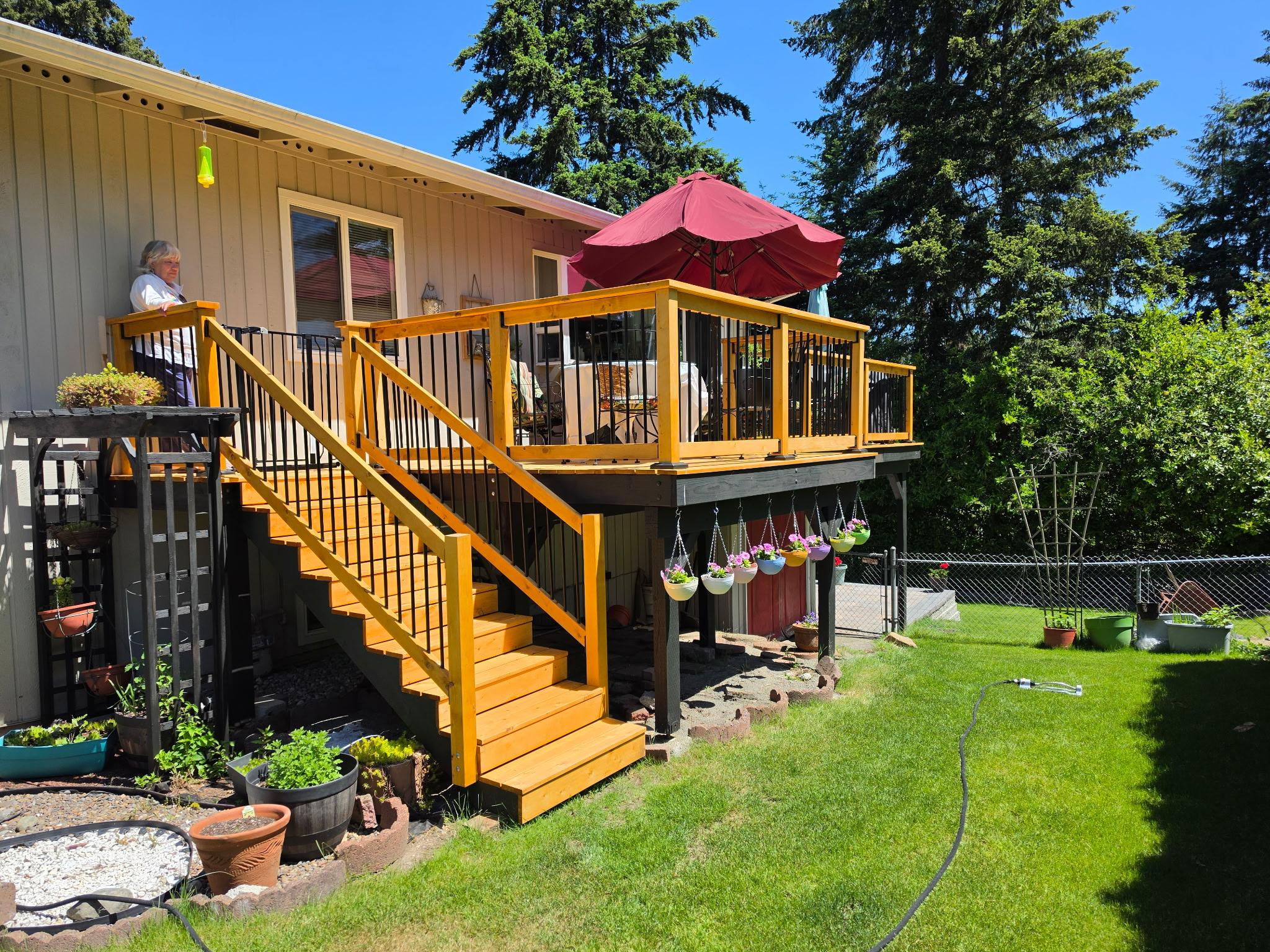
A deck takes more abuse than almost any other wood surface on a house. The boards sit flat, so rain and morning dew have time to soak in. Shoes, chair legs, and pets grind across them. Summer sun then dries them out again. Around Lake Tapps and Enumclaw, that cycle repeats for months every year.
So when a deck starts looking gray or worn, one of the first questions homeowners ask is whether to stain it or paint it. This guide explains the difference, what wood-finishing research says, and how to think about rails, stairs, and floors separately. It is general guidance. The right answer for your deck depends on the wood, its condition, and what is already on it.
Two families of finish: penetrating vs. film-forming
Most deck finishes fall into one of two groups.
Penetrating finishes soak into the wood rather than sitting on top. This group includes clear water-repellent preservatives and oil-based semitransparent stains. The wood grain still shows, and the finish wears away gradually instead of peeling.
Film-forming finishes build a continuous layer on the surface. Paint, solid-color stain, and varnish are in this group. They hide the grain and give a more uniform color, but the film has to stay intact to do its job.
What the research says about deck floors
The USDA Forest Products Laboratory has studied wood finishes for decades. Its publication Finishes for Wood Decks explains that deck lumber constantly shrinks and swells as its moisture content changes, and that film-forming finishes on decks also take heavy wear in high-traffic areas. For those reasons, it recommends penetrating finishes rather than film-forming ones for wood decks.
The reasoning is practical. A film that cracks lets water in behind it, and once water is trapped under paint, blistering and peeling tend to follow. A penetrating stain does not form that layer, so the same publication notes that oil-based semitransparent stain will not blister or peel even if extra moisture gets into the wood.
The Forest Service's Wood Handbook chapter on finishing wood makes a similar point. It also cautions that solid-color stains should not be used on horizontal surfaces unless they are specially formulated for decks, because they lack abrasion resistance and tend to fail by flaking.
Why this matters more in western Washington
Our climate leans hard on that moisture cycle. Western Washington typically has a long wet season followed by a drier summer, so deck boards spend months absorbing water and then dry out quickly in the sun. Shaded decks under firs and cedars can stay damp much longer than sunny ones.
A film finish has to survive all of that movement. A penetrating finish does not form a film, so it avoids that particular failure. It does wear, though, so it needs renewing more often.
Where paint and solid stain still make sense
None of this means paint has no place outside. The Forest Products Laboratory notes that railings do not need the abrasion resistance a walking surface does, and that paints and solid-color stains may perform quite well on them. The same is often true of skirting, fascia, posts, and trim that do not take foot traffic.
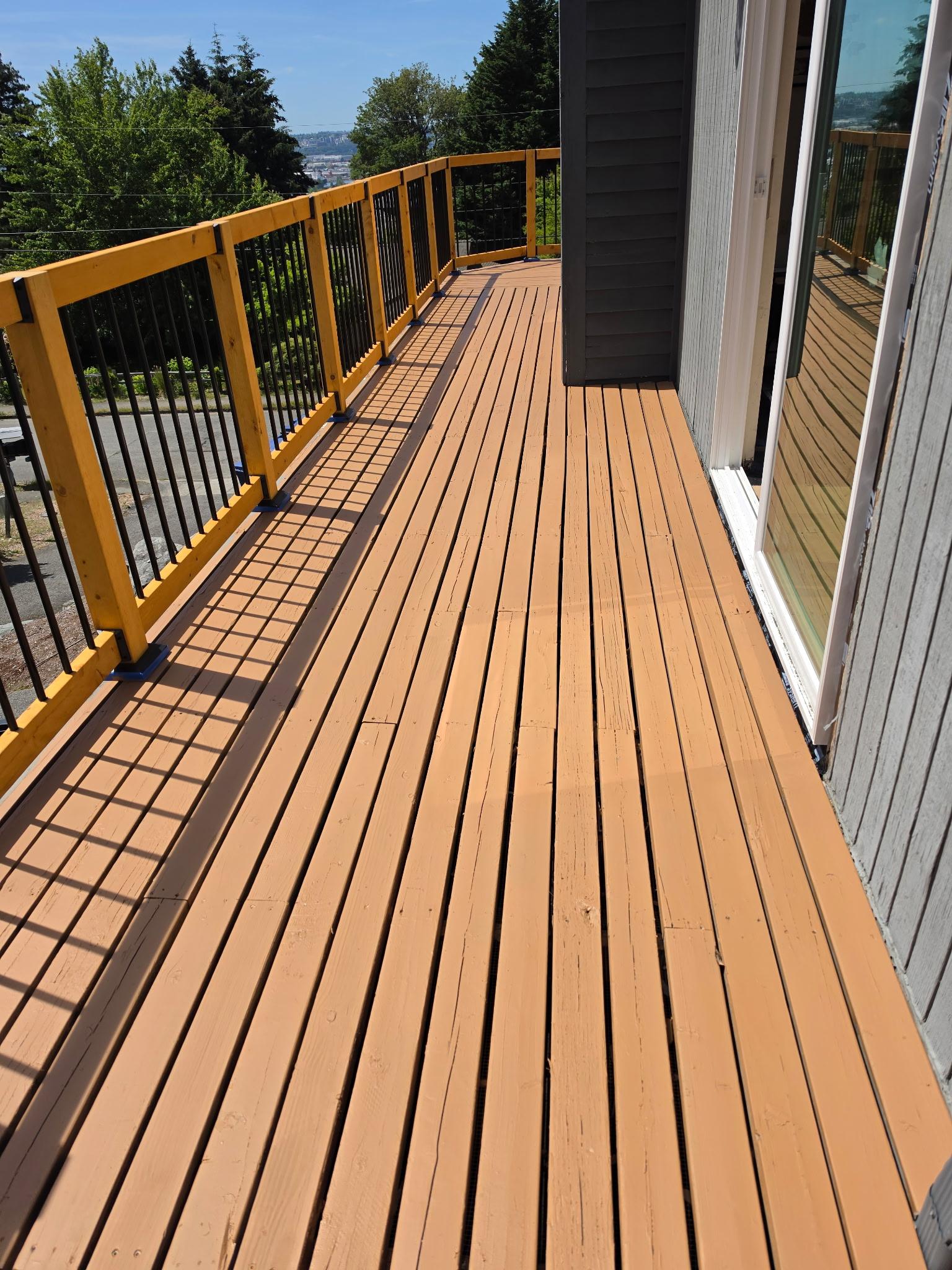
That is why many decks end up with a split approach: a penetrating stain on the floor and stair treads, and a solid color on the rails or trim to match the house.
Upkeep: easier to renew vs. longer between coats
There is a trade-off. The Forest Service's guide to choosing a finish explains how pigment helps a semitransparent stain last longer than a clear water repellent by absorbing UV that would otherwise break down the wood. Even so, penetrating finishes need refreshing more often than a sound paint film.
The benefit is that renewing them is usually simpler. Because there is no peeling film to scrape, recoating is mostly a matter of cleaning and reapplying. A failed paint film on a deck floor, by contrast, often needs significant scraping and sanding before anything new can go on.
How often any finish needs attention depends on sun, shade, foot traffic, the product, and how it was applied. Watch the deck rather than the calendar.
Signs your deck finish is due
Look closely at the boards, stairs, and rails, especially where people walk most:
- Water soaks in and darkens the wood instead of beading on the surface.
- Color has faded or worn through in traffic lanes and on stair treads.
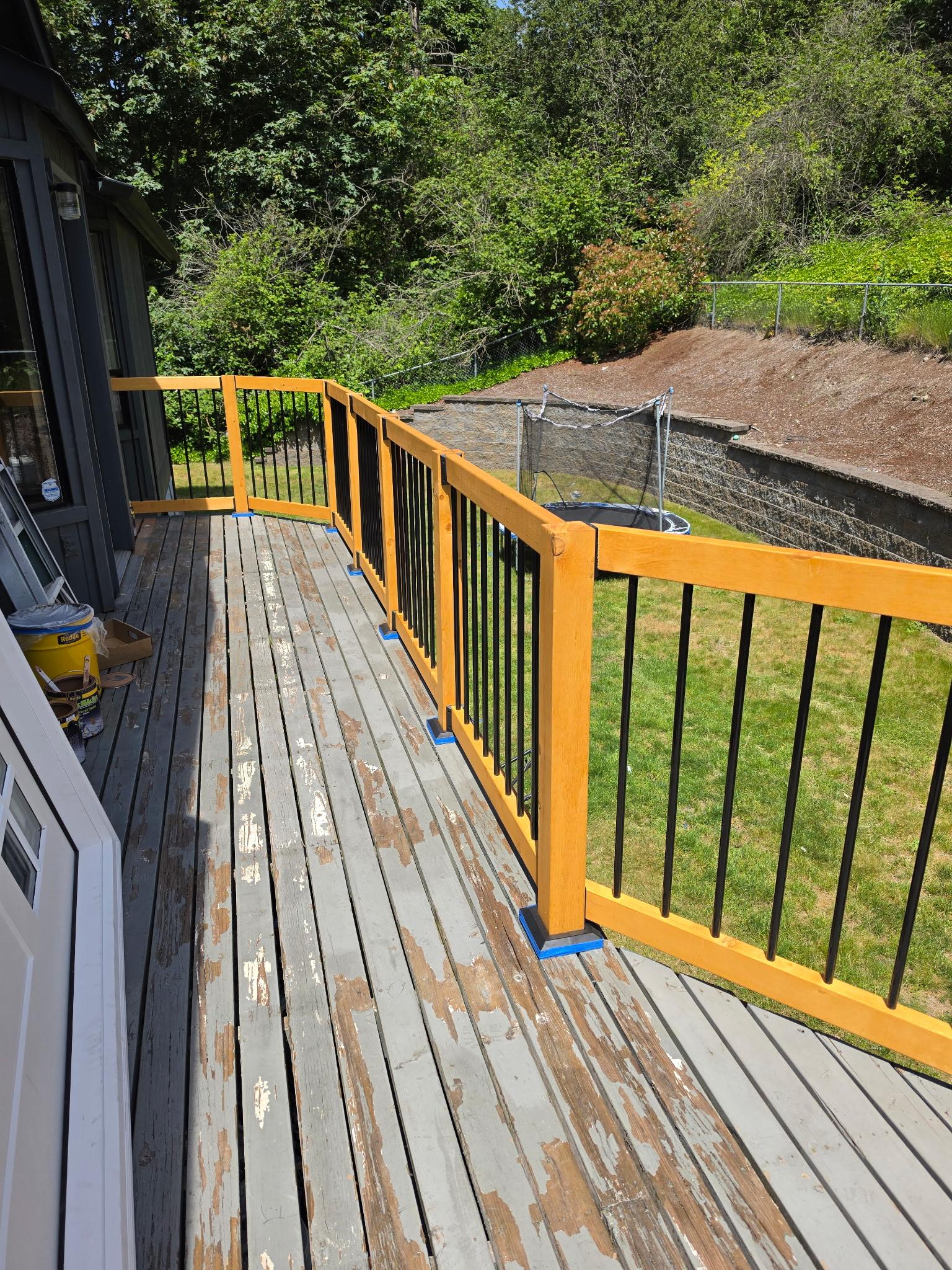
- Paint or solid stain is cracking, flaking, or peeling.
- Boards look gray, rough, or splintery.
- Mildew or green growth keeps coming back in shady spots.
- Soft or spongy boards, which point to repair before any finish.
Prep and timing
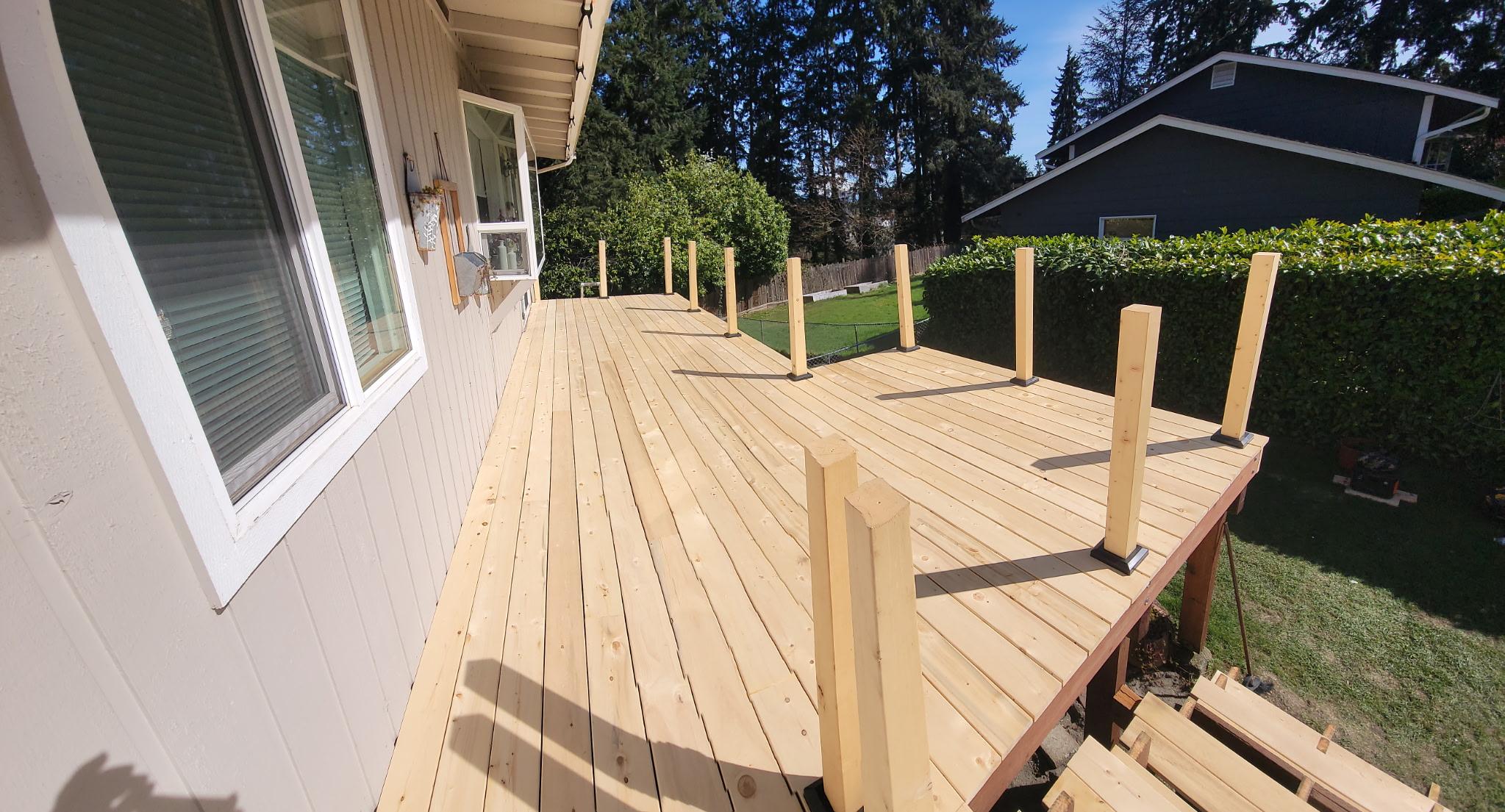
Whatever you choose, prep decides how well it works. That usually means cleaning off dirt and mildew, letting the wood dry thoroughly, sanding rough or raised grain, and repairing or replacing damaged boards first. The Wood Handbook also warns against over-applying semitransparent stain: put on more than the wood can absorb and it can form a film anyway.
Weather matters as much for decks as for siding. Follow the product label for temperature and dry time, and avoid applying when rain or heavy dew is on the way. Our earlier post on when to paint your home's exterior in the Lake Tapps–Enumclaw area covers dew point, surface moisture, and the dry-season window in more detail, and the same thinking applies here.
Getting help with your deck
Lane Home & Business Services builds, repairs, and stains decks and fences in Lake Tapps, Enumclaw, Maple Valley, Covington, and nearby. See our decks and fences service, repairs and carpentry for board and rail fixes, or exterior painting for the house itself. Call or text (253) 414-3937 or request a free estimate, and we can look at your deck and talk through the options.